· 5 min read
How to Shop Black Friday Beauty Sales Without Overbuying
Make a Black Friday beauty shopping list from what you already own: check stock and dates, set target prices, choose your rules and review every order.
By Vannie
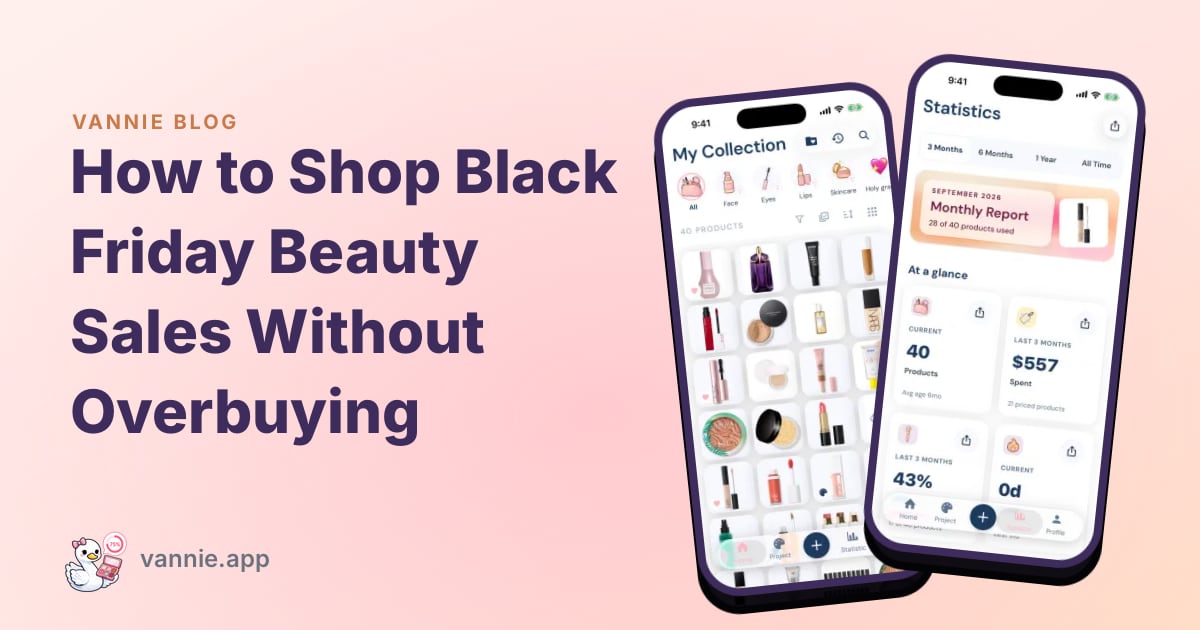
Black Friday falls on 27 November this year, and beauty sale emails usually start well before it. A shopping list written from your own collection, before the sales open, is the simplest way to buy what you need and skip the rest.
The aim is not to buy nothing. It is to arrive with a short list of products you have already chosen, the prices you are willing to pay and a plan for anything that was not on the list.
Start with what you already own
Before you open a single sale page, look through your collection by category. For each product you use often, note roughly how much is left and whether you already have a backup.
Three questions sort most products quickly:
- Will I run out of this in the next two or three months?
- Do I already own an unopened backup, or something that does the same job?
- Will I open it before its date matters? An unopened product has a printed date, and an opened one starts its period-after-opening clock.
If you are unsure how long something lasts once opened, the makeup expiry checker gives a typical range by product type. A discount does not help if a product will sit open in a drawer past its best.
Write the list in three columns
Split the list into needs, replacements and wants. Needs are products you are about to finish and use most days, such as foundation or mascara. Replacements are products you would buy again anyway in the next few months. Wants are everything else.
| Column | Example | Buy in the sale? |
|---|---|---|
| Needs | Foundation down to the last quarter | Yes, if the price suits |
| Replacements | A brow pencil you finish every few months | Yes, one only |
| Wants | A new eyeshadow palette | Only if it was on your list before the sale |
Keep the wants column short and specific: the exact product and shade, not "a new blush". Vague wants are where many impulse purchases come from. If a want has been on your list for weeks, it has passed a waiting period. If it appeared this morning in an advert, it has not. Our guide to using a wishlist to avoid impulse buying explains a simple waiting rule.
Set a target price before the sale starts
Write down the price you would be happy to pay for each item, then compare it with the usual price. A sale is only useful if the final price, including shipping, is at or below your target.
In Vannie, a Wishlist item can hold a target price and a preferred store, so the decision is made before the countdown timers start. When a sale goes live, you compare the offer with your own number instead of with the crossed-out price.
Watch for three common traps:
- Gift with purchase: a free bag of minis can push a basket over a spending threshold. Ask whether you would add that extra item if there were no gift.
- Bundles: a set is good value only if you would use every product in it. Divide the price by the items you actually want, not by the whole set.
- Shade guesses: a discounted foundation in the wrong shade is not a saving. If you cannot check the shade, leave it on the list for another day.
Decide your rules in advance
A few rules stop decisions from being made at the checkout. Choose the ones that fit your budget and your collection:
- A spending cap for the whole sale period, written down before Friday.
- One-for-one replacements only for anything in the needs column. Our replacement-only no-buy post covers how to define what counts.
- No new categories. If you do not wear lip liner today, a cheap lip liner set is not a need.
- A 24-hour pause for anything over an amount you choose.
If you track spending, last year's numbers make the cap easier to set. The beauty budget guide shows how to base it on what you actually bought rather than a guess.
Use a worked example
Here is an illustrative list for someone with a medium-sized collection:
- Foundation, nearly finished: target price 20% below usual, buy one.
- Mascara, opened four months ago: replace, one only.
- Cleansing balm, backup already owned: skip, even if discounted.
- Eyeshadow palette, on the wishlist since September: buy if it reaches the target price.
- Lipstick set seen in an advert today: add it to the wishlist and decide after the sale.
The list has five lines and three possible purchases. Everything else that lands in the inbox gets compared against it, and most of it can be deleted without a second look.
Review every order afterwards
When the parcels arrive, add each product to your inventory before opening it, with the price you paid. Note which column it came from. If something was not on the list, write down why you bought it: that reason is useful information for next year.
Check return windows for anything you are unsure about, and keep unopened products sealed until you decide. If a purchase turns out to duplicate a shade you already own, our post on how to stop buying duplicate makeup has a quick way to compare.
A short review in December turns this year's sale into next year's shopping list.
FAQ
Is Black Friday a good time to buy makeup?
It can be for products you would buy anyway, such as daily staples and replacements. It is a riskier time to try something new on impulse, because a discount can make an untested product feel like less of a gamble than it is.
How many backups should I buy in a sale?
Buy only as many as you will open before their dates matter. For most people that means one backup of a daily product. Products with short opened lives, such as mascara, are best bought close to when you need them.
What if I find a deal that is not on my list?
Add it to your wishlist with the price and wait until the sale ends. If you still want it and it fits your budget, you can decide then, with the rest of your list in front of you.
Keep the list next to your collection
A shopping list works best when you can see what you own while you decide. Get Vannie for iOS or Android to keep your products, backups and wishlist target prices together before the sales start.