· 2 min read
How Long Does It Take to Finish Makeup? Measure Your Own Pace
Learn how to measure your own makeup finishing time with dates, usage counts and consistent observations instead of relying on universal product timelines.
By Vannie
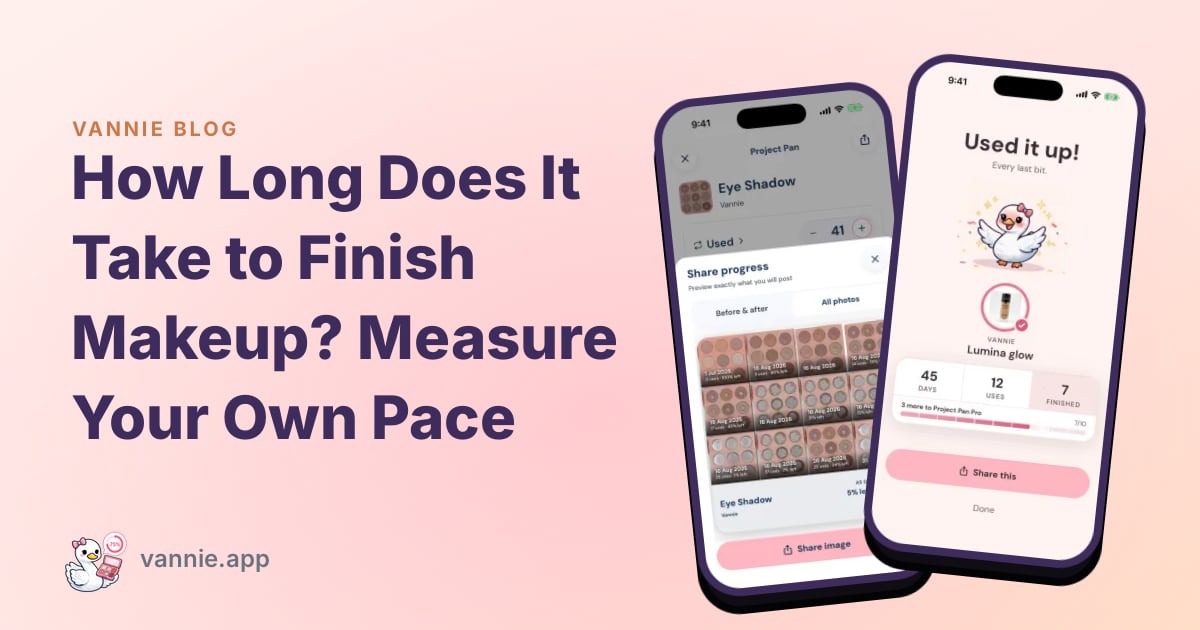
There is no single reliable finishing time for a lipstick, foundation or blush. The amount in the package, formula, application style and frequency of use all change the answer.
The most useful estimate comes from your own routine. You can measure that without promising a finish date or treating someone else's empty as a deadline.
Separate calendar time from number of uses
Calendar time tells you how long the product stayed in your routine. A usage count tells you how often you recorded using it.
Two people could finish a product after the same number of applications but take different numbers of months because one wears it more often.
Record both when you can. If you begin with a partly used product, describe the starting point instead of presenting the result as a full-product test.
Set up a small tracking experiment
Choose one product you already intend to use normally. Record the name, size, actual start date and starting condition.
Decide what counts as a use. One application session is a reasonable convention, but the choice should fit your question. Keep it consistent throughout the experiment.
Take a starting photograph if visible progress is possible. For opaque packaging, a short observation may be more honest than a made-up percentage remaining.
Keep ordinary use ordinary
Do not apply extra product to accelerate the result. The purpose is to understand your normal pace.
Record missed tracking days and any changes to the routine. If you alternate with another foundation, that context explains why the calendar time may stretch.
At a chosen interval, add a photograph or note. You are building a personal history, not a controlled laboratory measurement.
Use cautious calculations
Suppose an illustrative product has 60 recorded uses over 120 days. That is an average of one recorded use every two days.
If it is finished at that point, you can say that this particular product took 120 days from your recorded start and received 60 logged uses. You cannot conclude that every product in its category lasts 60 uses.
For an unfinished product, use the record to plan a usage target rather than claim an exact finish date. Product consumption may not remain constant, and visible progress does not always map neatly to quantity.
Be careful with weight measurements
If you choose to weigh a packaged product, use the same packaging configuration and a suitable scale each time. A lid missing at one measurement can create an apparent change that has nothing to do with the formula.
Total package weight is not the same as remaining product weight. Without a known empty-package weight, you cannot simply call the whole reading “product remaining.”
Small changes may also be within the scale's measurement limits. Treat the numbers as observations with limitations.
Turn the result into a better purchase decision
Once you have a finished-product record, ask what it suggests about size and backups. If an item took much longer than expected in your routine, another full-size backup may not be your next useful purchase.
Do not use an experiment to override the manufacturer's instructions or product-care information. Finishing a product is optional; accurate recording is the point.
Vannie connects inventory, usage counts, progress photos and empties. Get Vannie for iOS or Android and begin a personal record with one product you already plan to wear. You can learn from your own pace without needing a universal finishing-time chart.